

Gold Standard in Varicocele Surgery: Microsurgical Application
Varicocele surgery is a surgical procedure aimed at treating male infertility and eliminating chronic pain (orchialgia) developing in the testicle due to varicocele. It is medically impossible to treat varicocele with any medication, pill, or "herbal cure." Since the problem is mechanical vein enlargement at the anatomical level caused by valve insufficiency, the solution is also mechanical and surgical, by physiologically disabling that enlarged "faulty venous network."
However, not every varicocele surgery procedure offers the same surgical success, quality, or recurrence risk. In the medical world, across all guidelines of the American Urological Association (AUA) and the European Association of Urology (EAU), the only method accepted as the international standard and the Gold Standard for varicocele treatment is Subinguinal Microsurgical Varicocele Surgery.
Prof. Dr. Teoman Cem Kadioglu Difference
Prof. Dr. Teoman Cem Kadioglu, who pioneered the first microsurgical varicocele surgery in Turkey and subsequently accumulated over 6000 individual surgery cases over 30 years of this specific surgical approach, performs his surgeries routinely under a microscope. This extensive experience has reduced the recurrence risk during surgery to less than 1%, bringing varicocele recurrence and hydrocele complication rates to negligible levels.
How is the Decision for Surgery Made? Who Should Undergo Surgery?
The following patient groups with a varicocele that is **diagnosed via physical examination by a specialist** rather than ultrasound and has reached at least Grade 1-2 size fall under the indications (necessities) for surgery:
- Men who have been unable to achieve a pregnancy despite having unprotected sexual intercourse with their partner for at least 1 year (Infertility) and whose semen analysis values (sperm count, motility, or morphology) are below normal.
- Couples whose sperm parameters appear borderline but have pathological levels of DNA Fragmentation Index (DFI) and experience unexplained embryo losses/miscarriages during IVF attempts.
- Young men and adolescents who are unmarried or not yet considering children but are found to have a significant volume loss / softening in the left testicle by ultrasound or orchidometer (Adolescent varicocele).
- Pain complaints: Men of all ages who suffer from chronic, dull groin/testicular pain that severely reduces quality of life, affects work life, and is only temporarily relieved by painkillers or rest.
Why Do We Perform Microsurgery? (Comparison with Classical Methods)
For a surgery to be considered successful, three conditions must be met simultaneously: 1) Complete elimination of the problematic veins (minimizing recurrence to zero), 2) The artery carrying blood to the testicle (arterial structure) must never be cut or damaged (preventing testicular loss), 3) The lymphatic circulation must not be disrupted, avoiding swelling or fluid accumulation (hydrocele).
Historically, open classical surgery (Palomo, Ivanissevich methods), laparoscopic surgery, and radiological embolization have been used in varicocele treatment. However, today all of these have been abandoned or relegated to the background. The reasons are as follows:
- Open Classical Surgery: An operation performed with the naked eye or only with simple surgical loupes. The veins and the artery are millimeter-sized, stuck together, and the same color. Lymphatic channels are transparent, glassy structures, and impossible to see with the naked eye. In classical surgery, all vessels are ligated and cut together. This leads to fluid accumulation around the testicle, causing swelling up to the size of a tangerine (hydrocele disease) in 15-20% of cases. If the artery is accidentally cut, there is a risk of testicular atrophy, meaning shrinkage and loss of the testicle organ.
- Laparoscopic Surgery: A procedure performed by entering the abdomen through 3 ports and inflating it with gas. Its place in varicocele treatment is controversial because entering the abdomen for a single varicocele creates potential risks for the intestines and internal organs, and its recurrence rate is higher compared to microsurgery (10-15%).
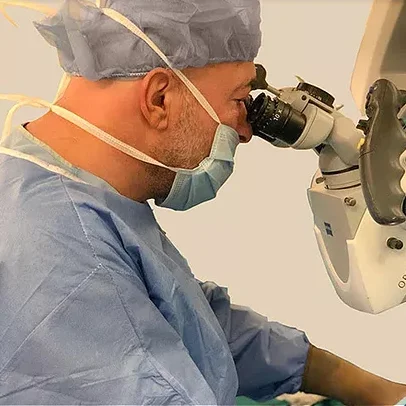
- Microsurgical Method (Gold Standard): The surgeon looks at the operation field through the screen and oculars of a high-tech, giant optical surgical microscope (such as Zeiss). The working area is optically magnified 10 to 20 TIMES. Thanks to this massive magnification:
- Testicular Artery (Artery): Every single pulsation on it is monitored very clearly under the microscope, and it is set aside and protected. It is never damaged.
- Lymphatic Channels: Although they are transparent, they shine like threads under that massive light and magnification. They are carefully dissected and left outside, reducing the 20% hydrocele risk down to the 0.1% range.
- Capillary Veins: Even tiny veins as thin as a hair, which cannot be seen with the naked eye and would enlarge 1-2 years after the surgery to cause a recurrence if left behind, are ligated and shut down. Consequently, the recurrence rate of the disease is literally under 1%.
Surgery Process and Step-by-Step Procedure
Microsurgical varicocele surgery methods, which maximize patient comfort, proceed in a very systematic way.
Step 1: Hospital Arrival and Preparation
The patient is admitted to his room at Acibadem Fulya Hospital approximately 2-3 hours before the scheduled surgery. He must fast completely for at least 6-8 hours (even drinking water is not allowed). If routine blood tests and ECG checks have not been performed beforehand, they are done in his room; the anesthesiologist visits the room to examine the patient and approves his file.
Step 2: Anesthesia and Surgical Incision
Depending on the patient's preference (along with doctor's approval), the surgery can be performed under general anesthesia (fully asleep) or spinal anesthesia (numbing from the waist down). The procedure is done from the area called "Subinguinal," right next to the pubic bone area where pubic hair ends. NO INCISION is ever made on the scrotum (testicular sac)! Only a small aesthetic incision of 3 cm for single-sided or 3 cm each on the right and left for bilateral surgeries is made to access and retrieve the vessel structures.
Step 3: Microscopic Work and Vessel Ligation
After the spermatic cord structures retrieved from under the skin are secured, the operating microscope is brought into play. During the detailed procedure under the microscope lasting about 1 to 1.5 hours, 3 main systems are controlled: All small and large branches of the internal spermatic veins are isolated with micro clamps, ligated, and divided. Transparent lymphatic channels are separated and preserved. The artery is identified and protected. After all target veins are ligated and divided, the small incision is closed with anatomical and aesthetic sutures using cosmetic materials that do not require suture removal.
Step 4: Discharge Process
After the surgery, the patient recovers quickly in his room and starts walking. Towards the evening of the same day, fluid intake and then normal food consumption are allowed. Since our patient, whose final checks are performed by Prof. Dr. Teoman Cem Kadioglu, experiences virtually no pain, he usually leaves the hospital on foot the same night, either driving his own car or accompanied by his relative, and returns home.
What Awaits You During the Recovery Process?
Thanks to modern microsurgery, the legacy, complex surgical concepts have been eliminated. Instead of long leg varicose vein surgeries, you will only have a 3 cm incision in an area the size of a palm. The process proceeds very quickly:
- Pain: Contrary to popular belief, no pain is felt in the testicle because the testicle is not touched. There is only a minor skin soreness at the site of the 3 cm incision, which is instantly relieved with simple painkillers (such as Majezik or Parol).
- Returning to Activity and Work: If your job is sedentary—such as office work, teaching, or software development—rather than active manual labor, construction, or professional sports, you can easily return to work or drive on the 2nd or 3rd day after surgery. Those doing heavy physical labor are advised to wait at least 10 to 15 days to avoid lifting weights.
- Bathing and Sexual Activity: Since the incision area is covered with a waterproof dressing tape or transparent gel tape, you can take short, warm standing showers 2-3 days after surgery, protecting the incision site as approved by your doctor. A period of 15 days is generally advised for full bathtub baths, swimming pools, or the sea. Sexual activity and ejaculation can be resumed naturally from the 7th or 10th day onwards, as soon as the patient feels comfortable. The myth that early masturbation causes varicocele to recur is completely false; however, waiting 10 days is reasonable to avoid any discomfort.
- Suture Removal: Since the surgical sutures used are made of completely organic, self-absorbing (absorbable) materials, you will not have any hanging threads or require suture removal, even if you look at it years later.
When Do Sperm Values Improve? When Does Pregnancy Occur?
A rule of nature to know is that it takes cumulatively about 72 to 90 days (roughly 3 months) for a new sperm cell (spermatogonium) in the human body to originate from the testicle's stem cells, divide, and become a mature, tailed, motile, and fertilizing sperm (spermatozoa). In short, the moment you have surgery and cut off that faulty blood flow to relieve the testicle, your sperm quality cannot "suddenly" increase that week. This is physically a cycle matter.
Therefore, the first and most accurate sperm control analysis after varicocele surgery should be performed after the 4th MONTH (around the 120th day) following the surgery. Earlier tests (in the 1st or 2nd month) only lead to disappointment and give misleading results. According to research and our experience, sperm motility and count increase by 70-80% in tests conducted between the 4th and 6th months. DFI (DNA Fragmentation Index) rates are significantly suppressed. Following successful surgeries, pregnancy typically occurs naturally (at a rate of 45%) within the 6 to 12-month period, creating highly successful outcomes.
Should Couples Go Straight to IVF Before Varicocele Treatment in Infertility?
One of the most common major wrong practices is that couples who bypass andrology clinics and directly visit gynecology/IVF units are included in "Microinjection / IVF" programs without even diagnosing that the primary cause of infertility is "Varicocele," or with the logic of "anyway, we have a few sperm, we will just inject them into the egg and handle it." Using sperm, especially low-quality sperm with advanced DNA damage due to varicocele, in IVF; not only drastically reduces the chance of IVF success but also increases the risk of embryo loss/miscarriage in the early months of pregnancy (early abortion) even if conception occurs. Instead of putting the mother-to-be through a major emotional toll and hormone load and incurring severe economic costs, repairing the underlying cause, Varicocele, with Microsurgery to normalize sperm values can bring natural pregnancy even in couples with 3 consecutive failed IVF cases.
Summary
Varicocele surgery is one of the most effective weapons against infertility, which does not threaten human life but fundamentally shakes the quality of life and "starting a family." The operation technique, perfected in thousands of cases by Prof. Dr. Teoman Cem Kadioglu, offers male patients a permanent, comfortable ticket to recovery with a 99% success rate.
If you would like to have information about detailed treatment strategies and other therapeutic alternatives for varicocele, you can continue reading our Varicocele Treatment or Does Varicocele Cause Infertility? guides.
This content was prepared by
Prof. Dr. Teoman Cem Kadioglu
Urology and Andrology Specialist
for patient education.